
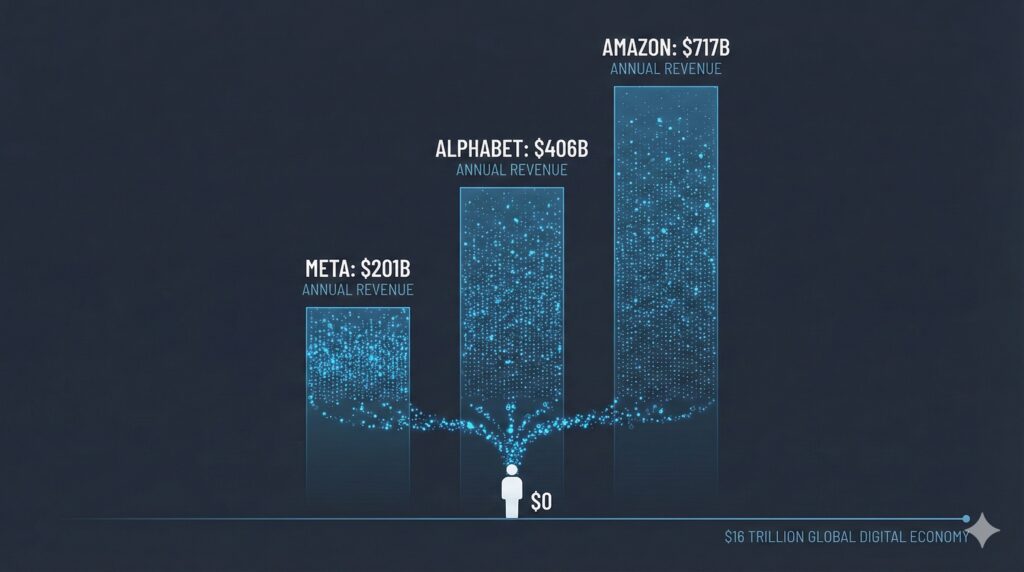
The data economy is worth trillions of pounds. Last year, three companies alone generated nearly £1.3 trillion in revenue by extracting, analysing and monetising your personal information. You were not invited to the negotiating table, and you are not seeing a single penny of the returns.
The Numbers: Scale of Extraction
Meta reported £201 billion in total revenue for FY2025, virtually all derived from advertising powered by your personal data, behaviour patterns and social connections. That revenue stream, once an experimental idea, is now the foundation of a digital empire.
Alphabet, which owns Google and YouTube, reached £406.2 billion in total FY2025 revenue, with the vast majority coming from advertising that depends on your search histories, email metadata, location tracking and browsing behaviour.
Amazon reached £716.9 billion in FY2025 revenue, with advertising revenue growing 22 per cent year-on-year as the company deepens its ability to target customers based on their purchase history and browsing behaviour. AWS, its data and infrastructure arm, now runs at a £142 billion annualised revenue rate, processing petabytes of data generated by millions of users.
These three giants are not outliers. The global digital economy is estimated at approximately £16 trillion, roughly 15 per cent of world GDP. The majority of this value is captured by platforms that do not own the underlying data but have successfully extracted its value. You generate it. They monetise it. The transaction is so transparent it is nearly invisible.
The Extraction Model: Free Services, Hidden Costs
The mechanism is deceptively simple. You trade your data, behaviour, location, social connections and preferences in exchange for “free” email, social media, search and cloud storage. The platforms have engineered this exchange so skilfully that most users believe they are receiving fair value. They are not.
The asymmetry is fundamental. You do not know what data is collected, how it is processed, who it is sold to, or how it is used to influence your behaviour. The platforms publish opaque privacy policies that few read and fewer understand. Your data is combined with data from billions of other users, enriched with third-party datasets, run through algorithmic models and weaponised for advertising, pricing discrimination and political influence. You see a fraction of a percentage of the value it generates.
You are not the customer. You are the product. And the product is not managed in your interest.
Why the Current Model Is Becoming Unsustainable
Three forces are cracking the extraction model from the inside. First, regulation. The General Data Protection Regulation has made the casual harvesting of personal data legally risky. Similar frameworks are emerging across jurisdictions. Fines are rising. Consumer expectations are shifting. Platforms are spending billions on compliance infrastructure that generates no revenue.
Second, data quality. The architecture of the extraction model creates perverse incentives. Platforms collect as much data as possible from as many sources as possible. This volume does not guarantee quality. Machine learning models trained on unverified, conflicting, outdated or deliberately polluted data produce unreliable outputs. The model that powers your targeted advertising is only as good as the data it consumes. As datasets grow, verification becomes harder and the risk of garbage output rises. Artificial intelligence is hungry for data, but it is also hungry for truth.
Third, security and privacy breaches. When platforms centralise the data they have extracted, they become targets. Breaches are routine now. Millions of records leak. Identities are stolen. Your personal information becomes a liability, not just for you but for the platforms holding it. The cost of a breach, including legal exposure, is growing faster than the revenue it generates.
The Alternative: User-Owned Data and Trust Infrastructure
An alternative architecture is emerging. Instead of centralised extraction, imagine a system where you own your data. You decide what is collected. You control access. You consent to specific uses. You receive compensation when your data is used commercially. Platforms compete to offer better services to users who have choice, not users who are trapped.
This requires three components. Decentralised identity: you own a cryptographic credential that proves who you are without a central authority controlling your identity. You control what information you share with each service you use. Reputation and verification: instead of platforms guessing who you are, you publish verifiable claims about yourself. Your education, your work history, your reliability. These claims are signed and can be independently verified. Trust is earned, not assumed. Data marketplaces: you own your data in a digital locker, encrypted and under your control. Services request access. You grant it. The transaction is recorded. You are compensated. The system is transparent.
A trust layer, powered by cryptography and distributed ledgers, enables this shift. Users own their identity and data. Services compete on the basis of what they offer, not on their ability to extract and exploit. Value flows to those who create it, not to the extractors who stand in the middle.
What Is Needed Now
The transition from extraction to user ownership will not happen by accident. It requires technical infrastructure, legal clarity and enterprise adoption. Standard-setting bodies are working on interoperable identity protocols. Enterprises are beginning to build consent-based data collection systems. Regulators are signalling that user control is a compliance requirement, not an afterthought.
The companies that are building these systems now are positioning themselves at the centre of the next wave of digital infrastructure. Those that do not adapt will find themselves competing on cost alone, with decreasing margins and increasing regulatory exposure.
The Shift Is When, Not If
The era of uncompensated data extraction is closing. Regulation is tightening. Users are demanding control. Enterprises are recognising that sustainable business models require trust, not exploitation. The shift from centralised data extraction to user-consented, user-owned, user-compensated data infrastructure is inevitable. The question is not whether it will happen, but who will build it and when.
Follow Ontology to stay ahead of the data economy shift.
