
Decentralised identity is the critical infrastructure layer that Web3 has been missing all along. Bitcoin fixed money. Ethereum fixed computation. But Web3 is still missing a critical layer: identity. Without decentralised identity, the entire promise of a user-owned internet remains incomplete. We have pseudonymous transactions, we have smart contracts, we have decentralised finance. But we lack the foundational trust mechanism that would allow real-world adoption at enterprise scale. This is not a feature gap. This is a systemic architecture problem. And it is solvable. The technology exists. The standards are published. The only missing piece is recognition of why this problem matters so urgently to the future of Web3.
The Identity Problem Web3 Cannot Ignore
Web3 has solved two fundamental problems: how to manage money without banks, and how to execute computation without a single authority. Yet it continues to rely on centralised identity systems. The paradox is stark: you can transact pseudonymously with perfect finality, but the moment you need to prove who you are, you must hand your data to a centralised authority. Email, phone number, government ID, facial biometrics, credit history. All of it collected, stored, and controlled by platforms that monetise that information. This contradiction runs against the core vision of Web3.
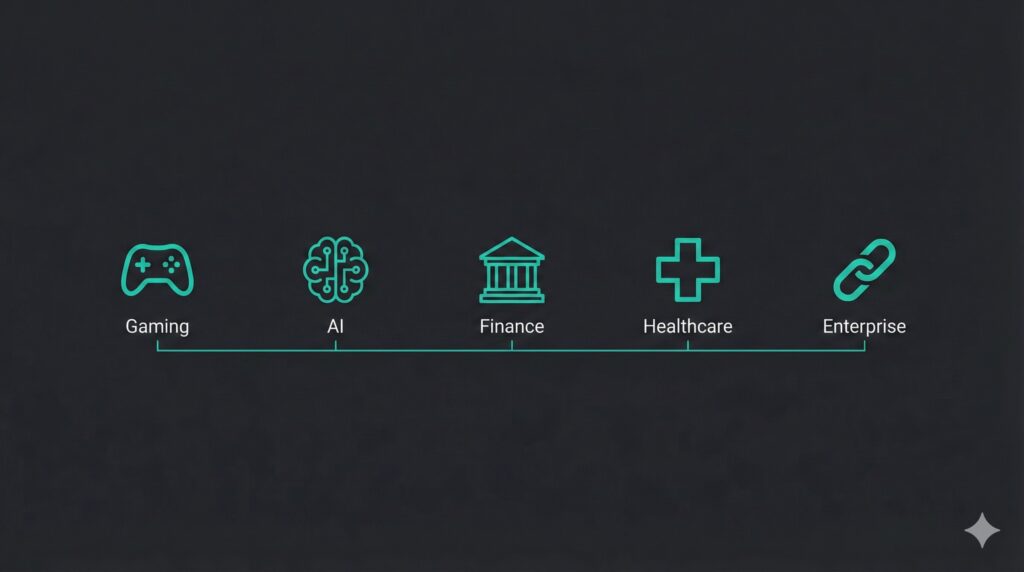
This limitation is already holding Web3 back from reaching its potential. Artificial intelligence companies cannot train models on high-quality, ethically-sourced data without verified consent and proven data provenance. Gaming platforms cannot port player reputation across chains because identity is not interoperable. Financial services cannot onboard users at scale because KYC processes are slow, expensive, and duplicated across institutions. Healthcare systems cannot build on decentralised networks because patient identity verification remains centralised and fragmented across provider networks. Enterprise supply chains cannot verify the credentials of participants without trusting a middleman. These are not theoretical limitations. These are concrete barriers to adoption.
The demand for solutions is already evident and growing rapidly. AI companies are facing mounting pressure to source training data ethically and transparently. Data scraping is facing legal challenges in multiple jurisdictions as regulatory frameworks tighten. An OECD policy paper on AI training data documents how scraping practices are facing legal challenges globally, driving enterprises toward verified, consented data sources. This economic incentive is powerful. This is the opening. This is why decentralised identity infrastructure matters now more than ever before.
What Decentralised Identity Actually Is
Decentralised identity is built on two open standards. The first is Decentralised Identifiers (DIDs), defined by the W3C DID Core specification. A DID is a unique identifier that you own and control, not a platform or authority. It is cryptographically verifiable and works across any blockchain, network, or system. It is not your email address. It is not your phone number. It is a portable, persistent identifier that belongs to you and only you. You can use the same DID across multiple platforms, multiple services, and multiple blockchains.
The second standard is Verifiable Credentials. These are digitally signed claims about yourself: your qualifications, your age, your citizenship, your medical history, your professional license. The key difference from traditional identity systems: you hold them, not a platform. You can present a credential to prove something about yourself without revealing everything. A doctor can verify you are over 18 without knowing your birth date. An employer can confirm you hold a specific certification without accessing your entire employment record. A financial institution can verify your creditworthiness without seeing all your transactions. This is attribute-based verification, not wholesale data transfer. This is consent-driven, not surveillance-driven.
Together, DIDs and verifiable credentials form a trust layer that is cryptographically sound, user-controlled, and interoperable across networks. This is what makes decentralised identity fundamentally different from centralised identity. In centralised systems, the authority holds your data and decides what it reveals. In decentralised identity, you hold your data and decide what to reveal. The power dynamic is inverted.
Why This Is an Infrastructure Problem, Not a Product Problem
A single wallet cannot solve identity. A single application cannot solve identity. A single blockchain cannot solve identity. Why? Because identity only has value at network scale. You do not need to prove your identity to yourself. You need to prove it to others, to systems, to institutions. The moment you try to build identity inside a single platform, you recreate the very centralisation that decentralised identity is meant to escape. The moment you lock identity into a single blockchain or ecosystem, you eliminate portability. You trap users and their credentials. This defeats the purpose.
This is why decentralised identity must be infrastructure, not product. You need a trust layer: a blockchain-secured foundation that any application, any platform, any service can build on top of. This is what makes identity interoperable and truly portable. Just as TCP/IP is invisible infrastructure for the internet (you do not think about it, you just use email and web browsers), decentralised identity needs invisible infrastructure. A foundation that every service trusts, but nobody controls. This is the enterprise-grade approach. This is what enables scalability. This is exactly what Ontology builds.
The Use Cases Are Already Here
Gaming and metaverses need portable reputation. A player with a verified track record on one platform should carry that reputation to another. No more starting from zero. No more siloed player histories. Decentralised identity makes this possible because the credential follows the user, not the game. Your gaming history becomes a portable asset.
Artificial intelligence companies need verified training data at scale. They need to know the data was collected with explicit consent, that it comes from the claimed source, and that it meets regulatory requirements in every jurisdiction. They need attribution and provenance. They need proof. Stanford HAI’s 2025 AI Index Report documents a surge in AI regulation globally, with U.S. state-level AI laws more than doubling in a single year. Data scraping lawsuits are multiplying. Decentralised identity with verifiable credentials solves this at scale.
Financial services need fast, low-cost KYC that actually works. Today, every financial institution collects the same identity information from you separately. No portability. No efficiency. Customers repeat the same verification process dozens of times. With decentralised identity, you provide proof once, and any regulated institution can verify it instantly. Compliance is maintained. Speed increases. Cost drops dramatically. This reduces friction and enables financial inclusion.
Healthcare systems need patient-controlled records. Medical data is sensitive, fragmented across providers, and difficult to port between healthcare systems. Patients lose access when they change providers. Data silos harm care coordination. Decentralised identity allows patients to hold their medical credentials directly and share them only with providers they choose. This improves care continuity and reduces medical errors.
Enterprise supply chains and workforce verification need credentials that survive beyond a single employer or platform. A safety certification, a professional license, a supplier credential should not disappear when you change jobs or when a company shuts down. With decentralised identity, a professional certification or safety clearance becomes portable and verifiable anywhere. Businesses can trust credentials without contacting the original issuer.
Each of these use cases is distinct, each serves different sectors, yet each benefits from the exact same infrastructure layer. This is the power of solving identity as infrastructure, not as product.
Network Effects: Why Identity Gets More Valuable With Scale
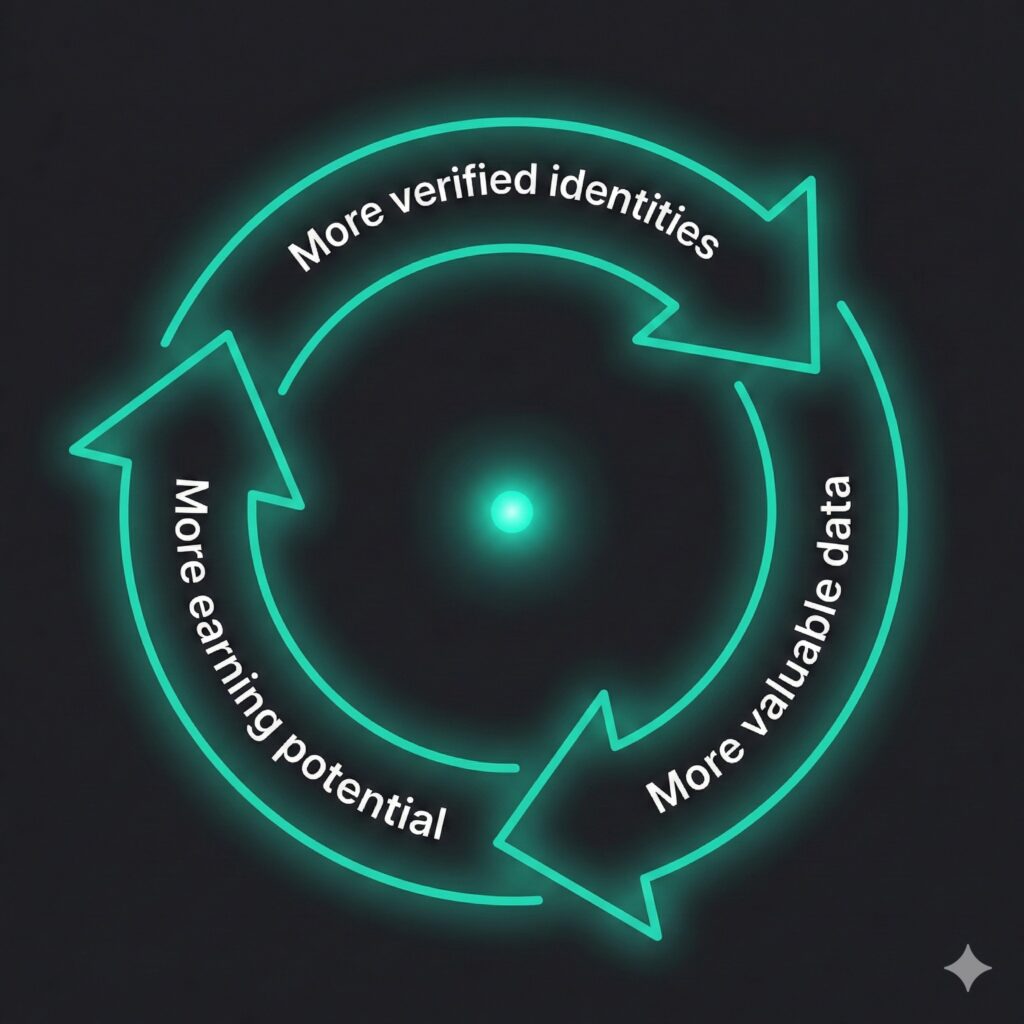
More users with verified decentralised identity means more valuable data available to buyers who need it. More data buyers willing to pay for verified sources means more earning potential for users who consent to share their data. More users earning income from their data means more participation and more network adoption. This creates a self-reinforcing flywheel. The infrastructure becomes exponentially more valuable as more participants join. First-mover advantage in building this infrastructure is real and significant. The early players will establish trust, liquidity, and network effects that create durable competitive advantages.
Connecting Identity to Your Broader Data Rights
For context on how identity is connected to your broader data rights, see our post on the three powers you did not know you had. And to understand why data control matters at the foundational level, revisit how your data is making billions. These pieces together paint a picture of why Web3 needs decentralised identity to achieve its vision.
Regulatory Frameworks Are Pushing Toward Decentralisation
Data regulations like GDPR have established that users have a fundamental right to access, control, and port their data. This is not a suggestion. This is the law in the European Union and increasingly in other jurisdictions worldwide. Yet centralised identity systems struggle to honour these rights. Decentralised identity is the technical architecture that makes these rights enforceable at scale and across borders. It transforms regulatory requirements from compliance burdens into technical features.
Decentralised Identity Is the Foundation, Not a Feature
Web3 needs decentralised identity to fulfil its original promise: a user-owned internet where individuals control their data, their identity, and their digital future. This is not speculation. This is not a distant vision. The infrastructure is built. The standards are published by the W3C. The use cases are waiting. The regulatory winds are blowing toward decentralisation. The question now is not whether decentralised identity is necessary. The question is who builds on it first and captures the value that comes with that first-mover advantage.
Follow Ontology to stay ahead of Web3 infrastructure developments. Visit ont.io to learn more about building on decentralised identity infrastructure.
